


Checkers Sixty60 Bags: A Creative Resource for Teaching Computational Thinking


With Coding and Robotics being introduced into schools, and Foundation Phase teachers looking for resources when trying to teach learners Computational Thinking skills, resources that are around us make the most sense, lids, bottles and Checkers Sixty60 paper bags should not be ignored.
Consider turning everyday waste into an educational treasure. Checkers Sixty60 paper bags offer a versatile, cost-effective way to introduce Computational Thinking (CT) to learners.
By utilising the familiar images on these bags, which are made from a firm, reusable thick paper, educators can bridge the gap between abstract digital concepts and tangible, real-world problem-solving.
Learners can be encouraged to be critical and creative thinkers with these easily available resources.
Core Skills
Computational thinking (CT) is a problem-solving approach that uses concepts from computer science, such as decomposition, pattern recognition, abstraction, and algorithm design, to tackle complex problems in a structured, logical way, making solutions understandable for both humans and computers.
It's a fundamental skill that helps learners break down issues, find similarities, focus on essential details, and create step-by-step instructions, applicable far beyond just coding.
Using the images from a Checkers Sixty60 bag, you can design "unplugged" activities to teach Computational Thinking to your learners.

Resources per group:
One Sixty60 grocery bag per group.
Cut out the Sixty60 grocery bag’s individual images apart.
Learners work in groups of 3 - 6 learners. Three to four learners is ideal group size.
Suggestion - place each group of pictures (one cut-up bag’s pictures) in their own plastic bag.
This assists with classroom management, ease of control and storage.
Computational Thinking (CT) - Sixty60 Unplugged Tasks
1. Decomposition
Definition: Breaking down information or complex problems into smaller, manageable parts
Activity:
Use the bag’s images to discuss the delivery process or an aspect of the process.
Example: Break down the details of an individual image into the smaller parts, such as a shopping basket picture.

Example: Grouping the same images together. Breaking the pile of pictures into the same ones.

2. Pattern Recognition
Definition: Looking for similarities among and within problems to find a sequence
Activity:
Learners use the different cut-out images from the bag’s set of pictures.
Ask learners to create a sequence
Then repeat the sequence to form a pattern

Allow learners to create their own sequence and then the pattern. Don’t give them an example.
You could stipulate how many components the sequence should have 2, 3, or more.
How many components does this sequence have? How many times was it repeated?
3. Abstraction
Definition: Identifying and representing essential features while ignoring unnecessary background details
Activity: Provide a variety of pictures. Ask learners to select only the essential items needed to solve a specific problem, while ignoring the rest of the pictures, such as:
What do we need to represent a delivery vehicle?
What is the item that represents the time?
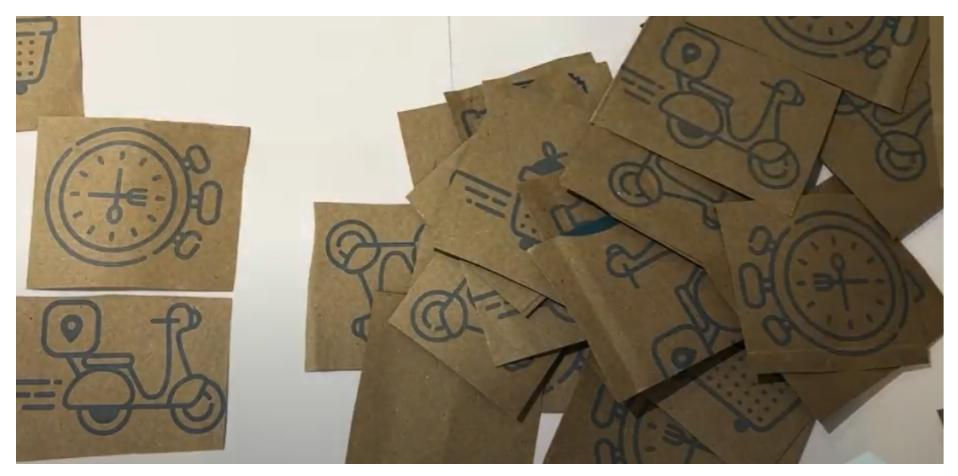
Provide all the same image, and learners to must identify the essential on which is different, and has a sticker or piece of a sticker on it.

4. Algorithm Design
Definition: Developing step-by-step instructions for solving a problem or completing a task
Activity:
Use the images to create a sequence of events or a grocery delivery story.
Learners to put the pictures into a logical order to describe the "algorithm" of a grocery delivery

Example: Learners can identify the individual steps required to go from a mobile order to a delivered grocery bag

5. Debugging
Definition: The process of finding and fixing errors
Activity: Create a "broken" sequence or pattern using the bag images.
Ask learners to find the mistake and correct it to make the "programme" work again.
Here, the teachers in a training session, are debugging sequence, and justifying their choices.

This teaches learners that it is okay to fail, but it is not okay to quit. Try and try again.

Why Use "Unplugged" Resources?
Following the Constructionism theory developed by Seymour Papert, learners build meaningful knowledge by taking advantage of the technologies and materials all around them.
Using Sixty60 bags encourages:
Creativity and Collaboration: Learners work together to build physical artifacts of their logic.
Accessibility: It removes the need for expensive hardware, allowing any classroom to engage with Coding and Robotics concepts

As the teacher
"Start from where YOU feel comfortable, and let the learners solve the problem!”
Using Checkers Sixty60 paper bags to build learners’ computational thinking skills in a fun way, with an available waste resource.


Comments